Glock model guide: standard, compact, subcompact and slimline
Glock builds one design in several frame sizes and eight calibers, and the model number tells you little on its own. This guide sorts the current catalog by frame size so you can pick a pistol by how you will use it: duty and home defense, everyday carry, deep concealment or competition. Figures are Glock's published specifications for 9mm models unless noted; check the product page for the exact pistol you are buying.
Standard frame
The standard or full-size frame is the original Glock 17 layout: a 4.49 inch barrel, a grip long enough for every finger and 17 rounds of 9mm in the magazine. It is the duty pistol size and the easiest Glock to shoot well. The same frame carries the Glock 22 in .40 S&W (15 rounds), the Glock 31 in .357 SIG (15) and the Glock 37 in .45 GAP (10). The large-frame Glock 20 in 10mm (15 rounds, 4.61 inch barrel) and Glock 21 in .45 ACP (13 rounds) share the standard length but use a wider grip.
Compact frame
The compact Glock 19 shortens the barrel to 4.02 inches and the grip by about half an inch, holding 15 rounds of 9mm. It is the best-selling Glock and the usual answer to the question of which one to buy first, because it carries well and still shoots like a full-size gun. Its stablemates are the Glock 23 in .40 (13 rounds), the Glock 32 in .357 SIG (13), the Glock 38 in .45 GAP (8) and the Glock 25 in .380 (15), which became available to US buyers in 2024.
Subcompact frame
The subcompact Glock 26 uses a 3.43 inch barrel and a short grip that hides 10 rounds of 9mm; it accepts every larger 9mm Glock magazine, so a 17-round spare works as a reload. The Glock 27 (.40, 9 rounds), Glock 33 (.357 SIG, 9), Glock 29 (10mm, 10) and Glock 30 (.45 ACP, 10) follow the same idea in bigger calibers. The Glock 36 is a single-stack .45 ACP with 6 rounds, and the Glock 39 is the .45 GAP version.
Slimline
Slimline pistols use a narrow single-stack frame about 1.1 inches wide. The Glock 43 holds 6 rounds of 9mm behind a 3.41 inch barrel; the Glock 43X keeps the barrel and adds a longer 10-round grip; the Glock 48 pairs that grip with a 4.17 inch barrel. The Glock 42 is the .380 ACP version with 6 rounds and a 3.25 inch barrel. Slimline magazines are their own pattern and do not interchange with double-stack Glock magazines. The 43X and 48 are also offered as MOS pistols cut for micro red dots.
Long-slide and competition
The Glock 34 (9mm) and Glock 35 (.40) stretch the barrel to 5.31 inches on a standard frame for a longer sight radius and are the usual choice for production and carry-optics divisions. The Glock 17L runs a 6.02 inch barrel in 9mm, the Glock 24 does the same in .40, the Glock 41 is a 5.31 inch .45 ACP, and the Glock 40 MOS is a 6.02 inch 10mm built for hunting with a red dot.
Crossover models
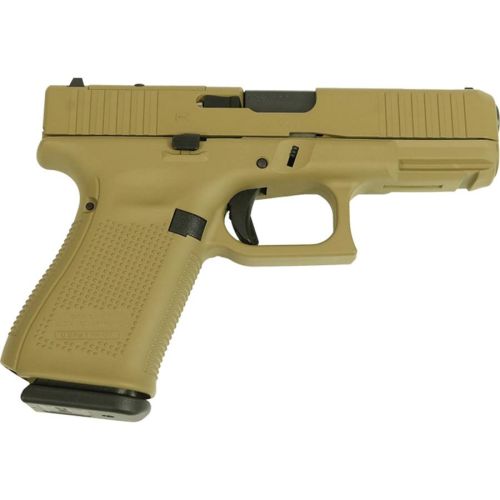
Glock has also mixed frames and slides. The Glock 19X puts a compact-length slide on a full-size grip in coyote tan and ships with 17 and 19 round magazines; the Glock 45 is the black version with front serrations. The Glock 47 is a full-size 9mm whose slide and barrel can be moved to a Gen 5 Glock 19 frame, and the Glock 49 puts a full-length slide on a compact frame. The Glock 44 is the .22 LR trainer in the Glock 19 outline with a 10-round magazine.
Grip width and hand size
Frame size is only half the fit question. The standard and compact 9mm frames are the same width, about 1.26 inches across the slide, and the Gen 4 and Gen 5 pistols ship with extra backstraps that add length to the grip for large hands. The 10mm and .45 ACP large frames are noticeably wider and longer in trigger reach, which is why some shooters with smaller hands struggle with a Glock 20 or 21 but shoot a Glock 17 comfortably. The slimline pistols go the other way: a 43X or 48 grip is thin enough that shooters who find a double-stack blocky often shoot them better, at the cost of five rounds. If you can, hold each frame size before buying; if you cannot, the compact 9mm frame is the safe middle choice for most adults.
Barrel length and what it changes
A longer barrel adds velocity, a longer sight radius and a little more weight out front, which steadies the pistol in recoil. The gap between a 3.41 inch Glock 43 and a 4.49 inch Glock 17 is worth roughly 50 to 80 feet per second with common 9mm loads and a large difference in how easy the sights are to align quickly. Below four inches, some defensive loads also fall short of the velocity they were designed for, so subcompact and slimline owners should choose ammunition tested from short barrels. None of this makes the small guns inaccurate; it makes them harder to shoot accurately at speed, which is the trade you make for concealment.
Picking a size
- Home defense and duty: Glock 17, 45 or 47; capacity and sight radius matter more than concealment.
- Everyday carry: Glock 19 or 48 for most people; Glock 43X when a thin gun is the priority.
- Deep concealment: Glock 43 or 42 in a pocket or ankle holster.
- Competition: Glock 34 or 17L, or a Glock 17 MOS with a dot for carry optics.
- Woods and hunting: Glock 20 or 40 MOS in 10mm.
Once you have the size, decide on the generation with the generations guide and the caliber with Glock calibers compared. Browse current listings in pistols or search the Glock catalog.
General information, not legal advice. Current as of September 2026. Laws change; check the official source before you act.