Glock generations explained: Gen 1 to Gen 5
Glock has changed its pistols in five broad steps since the Glock 17 arrived in 1982. The company calls them generations, and the generation of your pistol decides which slides, barrels, triggers, magazines and holsters fit it. This guide walks through each generation, what changed, and how to tell which one you own.
How to identify your generation
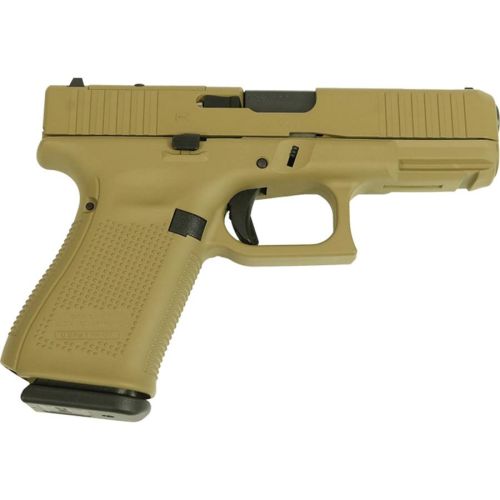
Look at the frame. A Gen 1 has a smooth pebble texture and no finger grooves. A Gen 2 adds checkering to the front and back straps. A Gen 3 adds finger grooves, thumb rests and an accessory rail under the dust cover. A Gen 4 keeps the grooves and rail, adds the rough RTF texture, a larger reversible magazine catch and a removable backstrap panel; it is also marked Gen4 on the slide. A Gen 5 drops the finger grooves, adds a flared magazine well and an ambidextrous slide stop, and is marked Gen5. Pin count helps too: 9mm Gen 1 and Gen 5 frames have two pins above the trigger, while Gen 2 (after 1990), Gen 3 and Gen 4 frames have three.
Gen 1 (1982 to 1988)
The original Glock 17 had a smooth grip, a flat-faced trigger guard, a two-pin frame and a slide with a plain rear. There was no rail and no third pin because the pistol was designed only for 9mm. Genuine Gen 1 pistols are collector pieces now. Most internal parts are interchangeable with Gen 2 and Gen 3, but the frame will not accept the later locking block with its extra pin.
Gen 2 (1988 to 1998)
Gen 2 introduced checkered grip straps, a steel plate with the serial number in the frame, and, from around 1990, a third frame pin above the trigger to support the locking block. The Glock 22 and 23 in .40 S&W arrived during this generation. Gen 2 magazines with the later full-metal lining feed fine in every generation that followed. Gen 2 frames are common in police trade-ins and take nearly all Gen 3 internal parts.
Gen 3 (1998 to today)
Gen 3 added finger grooves, thumb rests, an accessory rail and a loaded chamber indicator on the extractor. It is the longest-running generation and it is still built, partly because California's handgun roster froze the Gen 3 design in place and partly because the aftermarket for it is enormous. If you want the widest choice of slides, frames, barrels and triggers, Gen 3 is the pattern most makers cut first. A Gen 3 uses a single-spring recoil assembly, a small magazine release and the standard 9mm trigger housing.
Gen 4 (2010 to today)
Gen 4 kept the Gen 3 frame outline but changed the grip: the base grip is smaller, with a removable backstrap and medium and large panels in the box. The magazine catch grew and became reversible, which is why Gen 4 magazines carry a notch on both sides. The recoil spring became a dual-spring captured assembly, so a Gen 3 spring will not fit a Gen 4 without an adapter. The slide and barrel dimensions did not change, so a Gen 3 slide runs on a Gen 4 frame in most models.
Gen 5 (2017 to today)
Gen 5 is the current line. The finger grooves are gone, the magazine well is flared, the slide stop lever is on both sides, and the front of the slide has a slight bevel; many models also have front serrations. The barrel is Glock's Marksman Barrel with conventional rifling and a target crown, the finish is nDLC, and the 9mm frame went back to two pins with a new locking block. The trigger housing, ejector, firing pin safety and trigger bar are all Gen 5 parts and do not swap with earlier generations. Magazines are backward compatible: a Gen 5 magazine with the orange follower works in older pistols, and older magazines work in a Gen 5, though the slightly lipped floorplate is meant for the flared well.
What crosses generations
- Magazines: 9mm Glock magazines fit every generation of the same frame size, with the reversible-catch caveat for left-handed Gen 4 and Gen 5 setups.
- Sights: the dovetail and front sight hole are the same across all generations.
- Slides and barrels: Gen 3 and Gen 4 mostly interchange; Gen 5 slides need Gen 5 frames because the frame rails and locking block differ.
- Triggers and connectors: connectors are shared through Gen 4; Gen 5 uses its own trigger bar and housing, though the connector itself still fits.
- Holsters: a Gen 3, 4 or 5 of the same model fits the same holster in most cases, since the slide profile did not change; some tight molds catch the Gen 5 front bevel.
Which generation to buy
For a first pistol, buy the Gen 5 unless your state's roster or your parts plans point elsewhere: the trigger is smoother from the box, the grip suits more hands, and the ambidextrous slide stop is a real improvement. Buy a Gen 3 if you plan to build or heavily modify, if you live in California, or if you want a used police pistol at a low price. Buy a Gen 4 if you find one at a good price and want interchangeable backstraps with the older trigger parts. Whichever you pick, see the model size guide to choose between standard, compact, subcompact and slimline frames, and check the Glock catalog for current listings. Every pistol ships to a licensed dealer near you, explained in how to buy a Glock online.
General information, not legal advice. Current as of September 2026. Laws change; check the official source before you act.