Glock calibers compared: 9mm, .40, .45, 10mm, .380 and .22
Glock chambers its pistols in eight cartridges. Most buyers want 9mm and should probably get it, but the other calibers exist for good reasons. This guide compares them on recoil, capacity, ammunition cost, and what each is good for, and lists the models that come in each. Ammunition prices move, so treat cost comparisons as relative rather than exact.
9x19mm (9mm Luger)
The 9mm is the cartridge the Glock 17 was designed around and it remains the best all-round choice. Recoil is mild, magazines hold the most rounds for their size, and practice ammunition is the cheapest centerfire pistol round on the shelf. Modern bonded and expanding defensive loads perform on par with larger calibers in police testing, which is why most agencies moved back to 9mm over the last decade. Models: 17, 19, 26, 34, 17L, 19X, 45, 47, 49, 43, 43X, 48 and the MOS versions of most of them.
.40 S&W
The .40 was designed in 1990 as a compromise between 9mm capacity and .45 power, and Glock's 22 and 23 were the police standard for twenty years. Recoil is sharper than 9mm, capacity drops by two rounds, and ammunition costs more. The upside today is price: used .40 Glocks are cheap and plentiful, and a conversion barrel in .357 SIG or 9mm gives them a second life. Models: 22, 23, 27, 35, 24.
.45 ACP
The .45 ACP fires a heavy, slow bullet with a push rather than a snap. The Glock 21 holds 13 rounds in a wide frame, the Glock 30 holds 10 in a subcompact, and the Glock 36 is a single-stack 6-round carry gun. Ammunition costs roughly twice what 9mm does, and the wide grip does not suit every hand. It remains popular with shooters who like the recoil impulse and with those who want a large bore that shoots subsonic by default. Models: 21, 30, 36, 41.
10mm Auto
The 10mm is the most powerful Glock caliber, pushing bullets at magnum-revolver energy from a semi-automatic. The Glock 20 is a favorite in bear country and among hog hunters, and the Glock 40 MOS adds a 6 inch barrel and an optic cut for hunting. Recoil is stout with full-power loads, and a lot of commercial 10mm is loaded closer to .40 S&W levels, so read the box. Models: 20, 29, 40 MOS.
.357 SIG
The .357 SIG is a bottlenecked cartridge that pushes a 125 grain bullet at rifle-like velocity for a handgun, with a flat trajectory and strong barrier performance. Ammunition is expensive and harder to find than the others, and most agencies that used it have moved on. A .357 SIG Glock converts to .40 S&W with a barrel change, which makes the 31, 32 and 33 practical for the shooter who wants both. Models: 31, 32, 33.
.45 GAP
The .45 GAP was Glock's own answer to fitting .45 caliber bullets in a 9mm-width frame. The 37, 38 and 39 are pleasant to shoot, but ammunition availability is the problem: few makers load it, and it often costs more than .45 ACP. Buy one only if you already have a supply or want a collector's piece.
.380 ACP
The .380 is 9mm's smaller cousin, made for very small pistols. The Glock 42 is a slimline .380 for pocket carry, and the Glock 25 is a compact-frame .380 that became available in the United States in 2024. Recoil is light, which suits shooters with hand strength or arthritis concerns, but ammunition costs about the same as 9mm and defensive performance is a step down. Models: 42, 25, 28.
.22 LR
The Glock 44 is a .22 LR pistol in the Glock 19 outline with a hybrid steel and polymer slide. It is a trainer and a plinker: the controls and trigger match the centerfire pistols, ammunition costs a fraction of 9mm, and it lets a new shooter learn without recoil. It is not a defensive pistol, and it is picky about ammunition, so run high-velocity rounds.
Conversion barrels
Several Glock calibers share a case head, which lets one pistol run two cartridges with a barrel change. A .40 S&W Glock 22 takes a .357 SIG barrel directly, and both take a 9mm conversion barrel with 9mm magazines, since the 9mm case is narrower and the .40 extractor and ejector usually handle it. A 10mm Glock 20 takes a .40 S&W barrel with .40 magazines for cheap practice. The reverse does not work: a 9mm pistol cannot be converted up to .40, because the slide breech face and extractor are cut for the smaller case. Conversion barrels are a good way to buy an inexpensive used .40 and shoot it mostly in 9mm.
Recoil and follow-up shots
Caliber choice shows up on a timer more than on paper. In the same frame, a 9mm Glock lets most shooters fire accurate pairs faster than the .40 or .45 version, and the difference grows in a compact or subcompact pistol. The 10mm in a full-size Glock 20 is manageable because the pistol is heavy and the grip is wide, but in the subcompact Glock 29 it is a handful. If you are unsure, rent or borrow the caliber before you buy; a pistol you shoot well matters more than the number on the slide.
Choosing
- First pistol, defense, everyday carry: 9mm.
- Bear country, hogs, handgun hunting: 10mm.
- Cheap used duty gun: .40 S&W, with a 9mm conversion barrel later if you like.
- Recoil-sensitive shooter: .380 in a Glock 42 or 25, or a .22 LR Glock 44 to learn on.
- Large bore preference: .45 ACP.
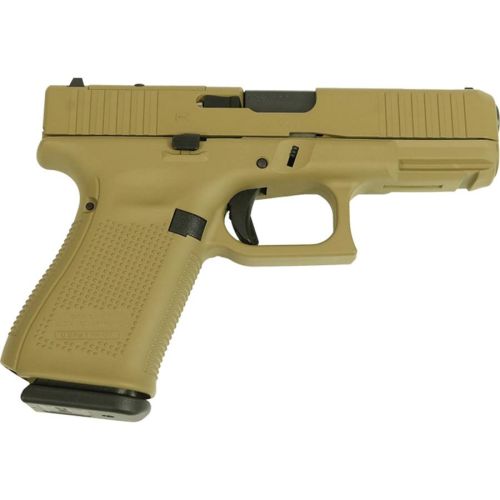
Every caliber shares the same operating system, so a shooter trained on one Glock can pick up any of them. See the model size guide for frame sizes, then browse the Glock catalog and the ammunition department.
General information, not legal advice. Current as of September 2026. Laws change; check the official source before you act.